AI governance and spend control for every model your company uses
Standard Compute puts Claude, GPT, Gemini and open models behind one company account. You decide who uses which model, which providers may handle your data and how much each person and app can spend, and every change is on record.
- How do we control AI spend per team and per person?
- Every person and app gets a fixed monthly budget that never overruns, and you can set spending caps per key and for the whole company. Optional top-off from a prepaid company balance keeps critical agents running.
- How do we control which models and providers are used?
- Decide which models each key can use, and choose exactly which inference providers may handle your data, for the whole company, a team or a single key. Lower levels can only narrow the rules.
- Is there an audit trail?
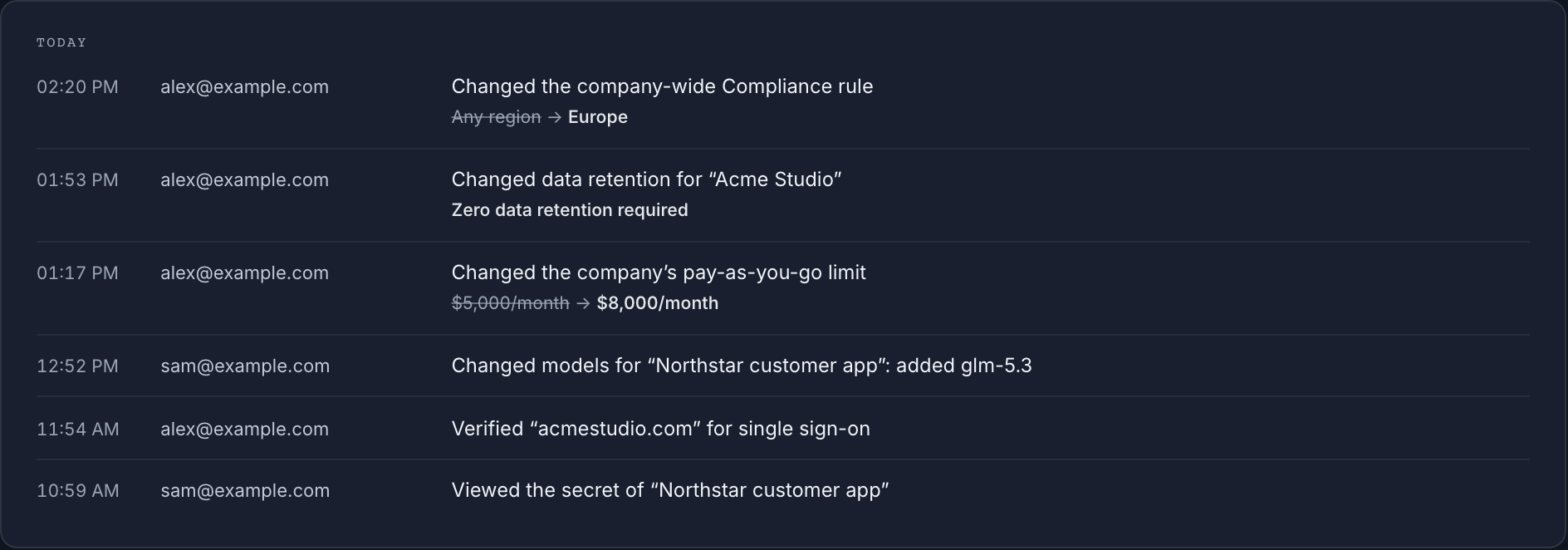
- Every admin change is recorded with before and after values, and you can export a record of every request showing the model, the provider that served it and the region rule in force, kept for 12 months.
One company account, a key for every person and app
Organize your company into teams, invite colleagues by email, and give every person and every app its own key, all under one company account. Usage is tied to a person or an application from the first request, so nobody needs a personal OpenAI or Anthropic key.
Admins manage people, keys, budgets and rules. Members use the keys they are given.
Budgets that stop where you set them
Each key has a flat monthly plan, and its budget is the plan price. When a key reaches its budget it stops, so the invoice holds no overage. Pay-as-you-go use has its own caps, per key and for the company as a whole.
For agents that must keep running, optional top-off lets a key continue on your prepaid company balance until the plan renews. Stripe invoices carry your company name and VAT number.
Providers and models you approve
Provider rules apply to the company, a team or a single key. A new provider is never added without an admin’s approval, and fallbacks can never route around your list.
Model rules apply to each key, so every app and every team member gets exactly the models you approve. That is how open models such as GLM, DeepSeek and MiniMax go to the applications you choose and frontier models to the ones that need them.
Set a Europe rule for your company, a team or a single key, and every request, including retries and fallbacks, is served only by approved European inference endpoints. Turn on zero data retention and every request is routed only to endpoints that commit to keeping no copy of your data.
A record of every change and every request
The admin audit log covers people, keys, plans, budgets and rules, and you can filter it by person or type of change.
The request log export runs over up to 12 months. Request records hold metadata only (model, provider, tokens, cost and status), never your prompts or outputs.
Records for your EU AI Act and GDPR work
Your legal team decides what the EU AI Act asks of your company. What the gateway gives that work is evidence: which models and providers each application is allowed to use, a request record for each call, a history of every admin change, and the region and retention rules in force.
For the data protection side, sign our Data Processing Agreement in the dashboard. It commits us to no training on your data, no retention of your content, and breach notification within 72 hours. We publish every sub-processor with its purpose, data and location, and give you 14 days’ notice before adding a new one.
What you can set, and at which level
| Capability | What it does | Set for |
|---|---|---|
| Teams | Group people and app keys under one company account | Set for: Company |
| Keys | A key for every person and every app | Set for: Person, app |
| Monthly budgets | Fixed monthly budget per key that never overruns | Set for: Key |
| Spending caps | Pay-as-you-go caps per key and for the whole company | Set for: Key, company |
| Top-off | Optional top-off from a prepaid company balance | Set for: Key |
| Provider allow-list | Only the inference providers you approve; new providers need an admin | Set for: Company, team, key |
| Model allow-list | Only the models you approve for each app or person | Set for: Key |
| Open models | GLM, DeepSeek, MiniMax and Kimi alongside Claude, GPT and Gemini | Set for: Key |
| Europe rule | Requests, retries and fallbacks served only by approved European inference endpoints | Set for: Company, team, key |
| Zero data retention | Requests routed only to endpoints that keep no copy of your data | Set for: Company, team, key |
| Admin audit log | Every admin change with before and after values | Set for: Company |
| Request log export | Model, serving provider and region rule for every request, kept for 12 months | Set for: Company |
| Data Processing Agreement | Signed in the dashboard | Set for: Company |
Questions from IT, security and finance
- Our OpenAI and Anthropic bills are exploding and nobody knows which team is spending what. How do companies set AI budgets per team?
- On Standard Compute every person and app has its own key and monthly budget, and keys sit in teams under one company account, so you see spend per key and can cap pay-as-you-go spend per key and for the company.
- What is the best way to set hard spend limits per team or per developer on LLM API usage, with automatic cutoff?
- Give each developer their own key on a flat monthly plan. The key stops when its budget is used, with no overage, and pay-as-you-go caps work per key and for the whole company.
- Tools to track and cap LLM costs per project across OpenAI, Anthropic and open-source models, something finance can read?
- Standard Compute puts Claude, GPT, Gemini and open models such as GLM, DeepSeek and MiniMax behind one company account, with a key and a fixed monthly budget per project app. Finance gets flat plans and Stripe invoices with your company name and VAT number.
- AI governance platform for a bank: audit logs, model allowlists, data controls. What are the options in 2026?
- Standard Compute gives you an admin audit log with before and after values, a 12-month request log export, model allow-lists per key, provider allow-lists per company, team or key, and Europe and zero-retention rules that teams and keys can never loosen.
- We need an audit trail of all LLM API calls for compliance, but without storing the prompt content. Is that a thing?
- Yes. Standard Compute keeps a record of every request with the model, the provider that served it and the region rule in force, exportable for 12 months, and request records hold metadata only, never your prompts or outputs.
- Shadow AI problem: devs using random API keys. What’s the standard way to centralize LLM access with logging?
- Put every model behind one company account, give every person and app its own key, and keep a request record for each call. On Standard Compute that comes with budgets per key and an admin audit log of every change.
- How do enterprises enforce which LLM models employees can use? We need a model allowlist, audit logs and per-team policies.
- Set the allowed models per key and provider and region rules for the company, a team or a single key. A team or key can tighten a rule set above it and never loosen it, and the audit log shows who changed what.
- What does the EU AI Act mean for a company using LLM APIs internally? Do we need logging of LLM usage?
- Your legal team decides what the Act requires of you. Standard Compute supplies the records that work usually asks for: the models and providers each application may use, a request record for each call kept for 12 months, and a history of every admin change.
- What should procurement ask an LLM API vendor about the EU AI Act, GDPR and data retention before signing?
- Ask where prompts are processed, whether content is retained or used for training, who the sub-processors are and what records you get. Standard Compute answers with a Europe rule, zero data retention, a DPA you sign in the dashboard, a public sub-processor list with 14 days’ notice, and a 12-month request log.
For your security review
The full picture of what Standard Compute offers companies is on the enterprise overview. What we store, where it is stored and how it is protected is on the security page, with the sub-processor list and the DPA next to it.
Create your company workspace, invite your team and set budgets and rules from the dashboard.
Create a company workspaceor write to contact@standardcompute.com