Cost allocation and chargeback for your company's AI spend
Finance wants to know which team, project or client used which model, and what it cost. The simplest answer is structural: give every person and every app its own key with its own fixed monthly budget, and run Claude, GPT, Gemini and open models through that one key.
Create a company workspaceor write to contact@standardcompute.com
Short answers
- How do we charge AI spend back to teams and projects?
- Organize your company into teams and give every person and every app its own key, all under one company account. A key on a flat monthly plan has a budget equal to its price, and pay-as-you-go use stops at the caps you set, so each project's AI cost sits on its own keys.
- What does Anthropic's own cost reporting cover?
- Anthropic's Usage and Cost Analytics API (beta since 29 October 2026) reports Claude token usage and cost for Claude Console and Claude Enterprise organizations, grouped by model, workspace, API key and the user or service account behind each request. Claude Enterprise added project tags for cost codes (beta) on 6 November 2026.
- What if the project also uses GPT, Gemini or open models?
- On Standard Compute, a single API gives you frontier and open-source models on the same key, so one key per project covers every model that project uses.
- Can spend overrun the number we allocated?
- Every person and app gets a fixed monthly budget that never overruns, and you can set spending caps per key and for the whole company. Optional top-off from a prepaid company balance keeps critical agents running.
Three ways companies allocate AI spend
Most companies start with one shared API key per vendor and try to split the bill afterwards. That works until a second team, a second vendor or an open model arrives. These are the three approaches we see, and where each one fits.
| Approach | How cost is attributed | Models covered | Fits when |
|---|---|---|---|
| The vendor's own analytics | How cost is attributed: Anthropic: by model, workspace, API key, user or service account, in daily, hourly or per-minute buckets. Claude Enterprise adds project tags for cost codes (beta) | Models covered: That vendor's models | Fits when: One vendor covers all your work and finance can join its API data |
| Shared keys plus your own tagging | How cost is attributed: Your code labels each request and your data team builds the report | Models covered: Any, if every team tags the same way | Fits when: You already run a data pipeline for usage |
| A key per project on Standard Compute | How cost is attributed: Each key belongs to a person or an app, sits under a team, and carries its own monthly budget | Models covered: Claude, GPT, Gemini and open models on the same key | Fits when: Several teams use several models and finance wants a fixed number per project |
Anthropic facts from its documentation and release notes, checked 7 November 2026. Sources are listed at the end of this page.
A key for every project, person or client matter
Organize your company into teams, invite colleagues by email, and give every person and every app its own key, all under one company account. A contract-review tool, a support bot and a client matter can each have their own key, and usage is tied to it from the first request.
Decide which models each key can use, so every app and every team member gets exactly the models you approve. The key also carries the rules your policy needs: a Europe rule, zero data retention or a provider allow-list.
Budgets that make the chargeback predictable
Each key has a flat monthly plan, and its budget is the plan price. When a key reaches its budget it stops, so the invoice holds no overage. Pay-as-you-go use has its own caps, per key and for the company as a whole.
For agents that must keep running, optional top-off lets a key continue on your prepaid company balance until the plan renews. Stripe invoices carry your company name and VAT number.
Records finance and audit can use
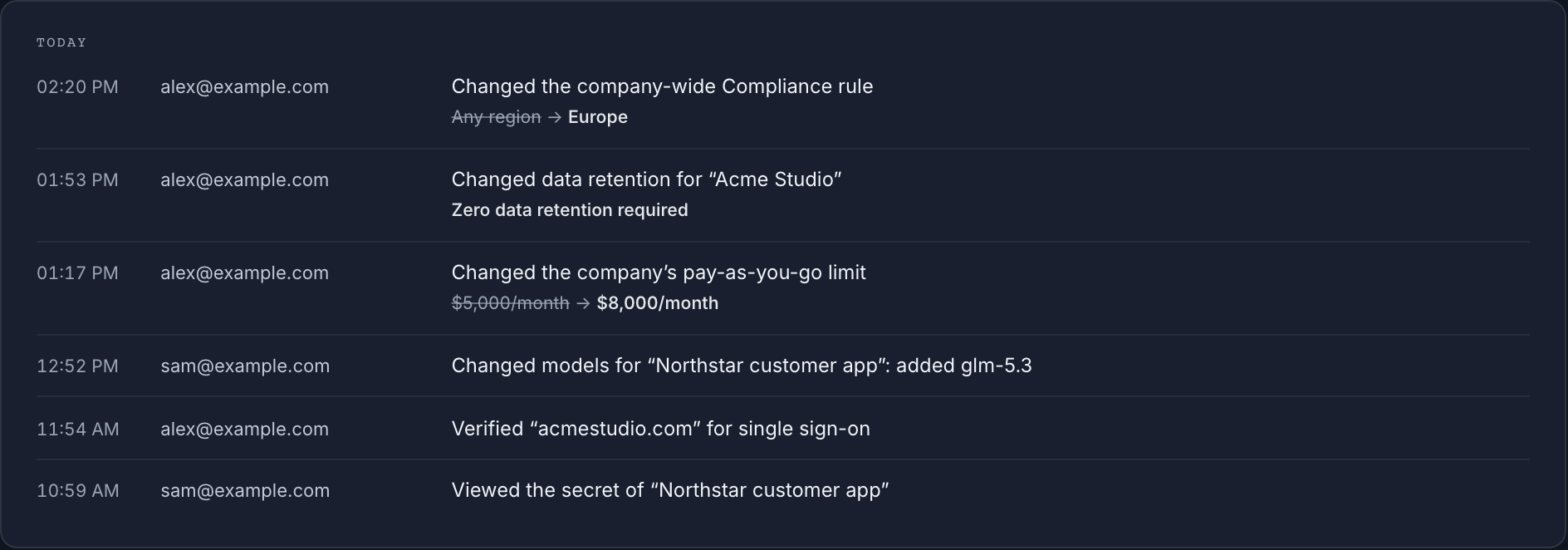
Every admin change is recorded with before and after values, and you can export a record of every request showing the model, the provider that served it and the region rule in force, kept for 12 months.
Request records hold metadata only (model, provider, tokens, cost and status), never your prompts or outputs, so the records can go to finance without exposing client content.
Lowering the number you charge back
A single API gives you frontier and open-source models, and it routes each step to the cheapest model that can do it and the cheapest provider fast enough to serve it. Routine steps go to open models and the hard reasoning step goes to a frontier model, so the same budget does more work.
# One key per project. The key carries the budget,
# the approved models and the region rule.
curl https://api.stdcmpt.com/v1/chat/completions \
  -H "Authorization: Bearer $CONTRACT_REVIEW_KEY" \
  -H "Content-Type: application/json" \
  -d '{
    "model": "standardcompute",
    "messages": [{"role": "user", "content": "Summarise the indemnity clause."}]
}'standardcompute lets the router pick the cheapest model that can do each step.Questions from IT, security and procurement
- How do companies do chargeback for LLM API costs per department?
- Give each department its own keys under one company account, with a fixed monthly budget on each key. The department's AI cost is then the sum of its keys, whatever mix of Claude, GPT, Gemini and open models it used.
- Can a law or consulting firm track AI spend by client matter?
- Yes. Create a key for each matter or engagement and give it a monthly budget. Request records hold metadata only, never prompts or outputs, so the cost record never contains client content.
- Does Claude Enterprise support cost allocation by project?
- For Claude, yes: project tags for cost codes (beta since 6 November 2026), pooled group budgets since 28 October 2026, and the Usage and Cost Analytics API. Spend on other vendors' models sits outside those reports; through Standard Compute it runs on the same keys and budgets as Claude.
- Can we restrict which models a project may use?
- Yes. Decide which models each key can use, and a request for a model outside a key's list is rejected, so a project's cost stays within the models you approved for it.
- What does finance receive at the end of the month?
- Flat monthly plans per person or app and Stripe invoices with your company name and VAT number. Enterprise features can be bought one at a time or together; see pricing.
- Can we keep project data in Europe as well?
- Set a Europe rule for your company, a team or a single key, and every request, including retries and fallbacks, is served only by approved European inference endpoints. If no European endpoint can serve it, the request is refused before your prompt is sent.
Related pages
- AI governance and spend control
- Standard Compute for companies
- Claude Enterprise alternative
- Claude rate limits for teams
- Pricing
Sources
- Anthropic: Usage and Cost Analytics API, checked 7 November 2026
- Anthropic: Claude Platform release notes (29 October 2026), checked 7 November 2026
- Anthropic: Claude app release notes (project tags, 6 November 2026), checked 7 November 2026
- Anthropic: manage pooled group budgets on Enterprise plans, checked 7 November 2026
Create your company, give each project its own key and budget, and give finance a cost for every project.