AI gateway for healthcare that keeps patient data out of storage and in Europe
Standard Compute is the AI gateway healthcare providers, health tech companies and life sciences teams use to work with Claude, GPT and open models while patient data stays out of storage and inside Europe. Through one API, each step goes to the cheapest model that can do it.
The data protection officer sets the rules for the whole organization: a Europe rule, zero data retention, no training, approved providers only, and a record of every request without a single prompt in it.
Create a company accountor write to contact@standardcompute.com
The short answers
- Can clinicians and health apps use large language models without patient data being stored?
- Turn on zero data retention and every request goes only to inference endpoints that commit to keeping no copy. Standard Compute processes prompts in memory and never writes them to storage or logs.
- Is patient data processed in Europe?
- With a Europe rule, every request, including retries and fallbacks, is served only by approved European inference endpoints, and a request no European endpoint can serve is refused before the prompt is sent.
- Does the request log contain health data?
- No. Request records hold metadata only (model, provider, tokens, cost and status), never prompts or outputs.
Your requirements, mapped to product controls
What a hospital's data protection officer and security team check before patient data reaches an AI model, and the control that answers each one.
| What the sector asks for | How Standard Compute handles it |
|---|---|
| Health data handled as a special category under GDPR Art. 9 | Turn on zero data retention and every request is routed only to inference endpoints that commit to keeping no copy of your data. We process prompts in memory and never write them to storage or logs. Standard Compute never trains on your prompts or outputs. |
| Processing location the organization can document | Set a Europe rule for the company, a team or a single key. Every request, including retries and fallbacks, is served only by approved European inference endpoints, and a request no European endpoint can serve is refused before the prompt is sent. |
| No patient content in logs | Account and usage records are stored in Frankfurt and the EU gateway runs in Finland. Request records hold metadata only (model, provider, tokens, cost and status), never prompts or outputs. |
| Only approved processors and sub-processors | Choose exactly which inference providers may handle your data, for the company, a team or a key. Lower levels can only narrow the list, new providers never join without an admin's approval, and fallbacks never route around it. Sign the DPA in the dashboard in minutes: no training on your data, no retention of your content, breach notification within 72 hours. Every sub-processor is published, with 14 days' notice before a new one is added. |
| Role-based access tied to the organization's directory | Connect Microsoft Entra ID or any SAML identity provider. Anyone on your verified domain joins the company automatically, and access to Claude Desktop and Claude Code follows your Entra groups through SCIM. |
| Approved models per clinical and research application | Decide which models each key can use, so every app and every person gets exactly the models you approve. GLM, DeepSeek and MiniMax run on European providers for Europe-restricted workspaces. |
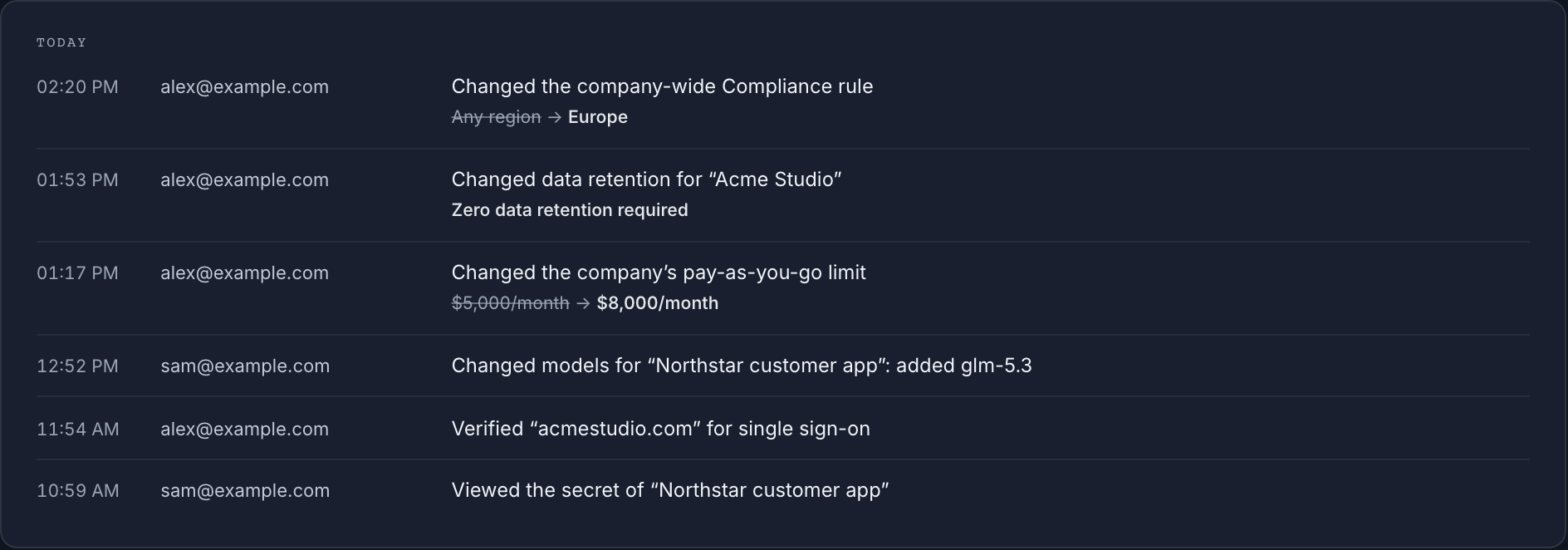
| Traceability of use | Every admin change is recorded with before and after values. Export a record of every request showing the model, the provider that served it and the region rule in force, kept for 12 months. |
| Budget per application and per researcher | Every person and app gets a fixed monthly budget that never overruns, with spending caps per key and for the whole company. |
Set it up in an afternoon
Create the company account
Invite colleagues by email, organize them into teams, and give every person and every app its own key.
Set the Europe rule and zero data retention
Set both for the whole company. Teams and keys inherit them and can never switch them off underneath you.
Connect Microsoft Entra ID
People sign in with their work accounts, and employees use Claude Desktop and Claude Code with their Microsoft work account through our EU gateway.
Approve providers and models, then sign the DPA
Choose which inference providers and models each key may use, set the budgets, and sign the DPA in the dashboard.
Regulation references
The rules buyers in this sector check first, linked to the official text. They are references for your own assessment.
Links checked 9 November 2026.
Questions from IT, security and procurement
- Does Standard Compute train on patient data?
- No. Standard Compute never trains on your prompts or outputs. With a region rule or zero retention on, every request goes only to providers that commit not to train on it.
- Can we limit which models a clinical application uses?
- Yes. Each key, including application keys, has its own approved models. Requests for any other model are refused.
- Does Standard Compute sign a DPA?
- Yes. Sign our Data Processing Agreement in the dashboard in minutes. It commits us to no training on your data, no retention of your content, and breach notification within 72 hours.
- Can open models be used for research workloads?
- Yes. Run GLM, DeepSeek and MiniMax alongside Claude, GPT and Gemini through one API. GLM, DeepSeek and MiniMax are also served by European providers for Europe-restricted workspaces.
Read next
Other sectors
Create the company account, set the Europe rule and zero data retention, and your people can start the same day.