Using LLMs in an Irish company: what the Data Protection Commission expects
Updated 18 November 2026
Ireland's Data Protection Commission (DPC) set out in July 2024 what an organisation should check before it uses an AI product such as a large language model: whether a formal risk assessment is needed, what personal data the tool uses and where it goes, whether the provider keeps or re-uses it, how people's rights are met, and that outputs are not relied on without critical human review. In September 2026 the DPC published its AI Insights Report on its supervision of around 180 AI products and services.
Create a company workspaceTalk to usor write to contact@standardcompute.com
This page summarizes the DPC's published material with links to the originals, turns it into tasks for a company and the controls that answer them, and shows the technical part an AI gateway handles. It summarizes public guidance and is not legal advice.
What does the DPC say, in short?
- Does the GDPR apply when staff use an AI tool?
- Yes, whenever personal data is processed. The DPC names data your employees or your customers type into an AI tool as a source of risk, particularly when a third party processes it, and asks organisations to understand how that data is protected both in their own hands and in the provider's.
- What should we check before using an LLM product?
- According to the DPC: what personal data the product uses and how, where that data goes when a third party is involved, whether the provider retains or re-uses it, how the product supports your GDPR obligations, whether you can answer an access or deletion request for data held in the AI system, and your retention schedule. If you are a controller, consider a formal risk assessment.
- What is the DPC's AI Insights Report?
- "Responsible Artificial Intelligence Innovation", published on 25 September 2026: insights from the DPC's supervision of around 180 AI products and services between 2021 and 2025. It highlights legitimate interests as a legal basis for AI training and robust transparency, and concludes that early engagement with the regulator is the most effective path to responsible innovation.
What does the DPC ask of organisations using AI products?
AI, Large Language Models and Data Protection, Data Protection Commission, 18 July 2024
- If your organisation is a data controller for the use of an AI system, a formal risk assessment should be considered.
- Before you start using an AI system, understand what personal data it uses and how, and where the data goes when a third party is involved in the processing.
- Establish whether the provider of the AI product retains your data or re-uses it in any way.
- The provider's documentation should tell you, in an understandable form, how the product handles personal data and how it supports your GDPR obligations.
- Put processes in place for data subject rights: can you respond if someone asks for access to, or deletion of, their data held within the AI system?
- Understand how personal data is protected, both when you process it and when another organisation processes it on your behalf. Data your staff enter into a tool is a source of risk.
- Without a retention schedule you risk breaching the storage limitation principle.
- Relying on outputs without critical human analysis or intervention creates automated decision-making risk, especially where outputs affect people.
What did the DPC learn from supervising AI products?
Data Protection Commission publishes AI Insights Report, Data Protection Commission, 25 September 2026 · PDF
- The report, "Responsible Artificial Intelligence Innovation, Insights from the Data Protection Commission's Supervision of AI (2021-2025)", covers the DPC's engagement with controllers on around 180 AI products and services.
- The DPC assessed thousands of pages of briefings, risk assessments, technical and organisational measures and compliance documentation.
- Its focus areas include legitimate interests as a legal basis for AI training and the need for robust transparency for a novel technology.
- The DPC concludes that early regulatory engagement is the most effective path to sustainable, responsible innovation, and that innovation and rigorous data protection are not mutually exclusive.
What does the DPC's guidance mean for a company, and which controls answer it?
A practical reading of the DPC's points for an Irish company rolling out AI assistants, LLM APIs or agents: each task, what it requires, and the controls that make it possible.
A risk assessment per use
A formal risk assessment, or a DPIA where the processing is high risk, before personal data goes in. Control: a register of AI uses and a separate key for each app.
Know where data goes
A data map for every AI tool: which provider serves each request and in which country. Control: a restriction on where requests are processed, a provider allow-list and a published sub-processor list.
No re-use, defined retention
Confirmation that the provider neither keeps nor re-uses your data, and your own retention schedule. Control: zero data retention at the inference provider and a DPA clause.
Rights you can answer
A process for access and deletion requests about data that went through an AI system. Control: zero data retention at the inference provider and request records that hold metadata only, never prompts or outputs.
Staff input rules
Written rules on what staff may enter, and training. Control: an AI usage policy, approved tools only, and work-account sign-in.
Human review
Outputs that affect people are checked by someone who can change them. Control: a process description and staff instructions.
Security of the supply chain
Know how each provider protects data on your behalf. Control: the provider's DPA, sub-processor notice and an audit log of configuration changes.
Which part does an AI gateway handle?
The risk assessment, legal basis, transparency to people and human review remain the company's work. Standard Compute, an AI gateway to frontier and open-source models, answers the questions about where data goes, who keeps it, which providers and models each key may use, who has access, and what record remains.
Where data is processed
Set a Europe rule for your company, a team or a single key, and every request, including retries and fallbacks, is served only by approved European inference endpoints. If no European endpoint can serve it, the request is refused before your prompt is sent. Claude runs in Europe on Google Vertex AI and on Amazon Bedrock in Ireland. Our EU gateway terminates TLS and runs in Finland, and your account data is stored in Frankfurt.
No training, no retention
Turn on zero data retention for your company, a team or a key, and every request is routed only to inference endpoints that commit to keeping no copy of your data. We process your prompts in memory to serve each request and never write them to storage or logs, and Standard Compute never trains on your prompts or outputs.
A DPA you can sign
Sign our Data Processing Agreement in the dashboard in minutes. It commits us to no training on your data, no retention of your content, and breach notification within 72 hours. Transfers to a country without adequacy are covered by the EU Standard Contractual Clauses and, for UK data, the UK International Data Transfer Addendum. We publish every sub-processor with its purpose, data and location, and give you 14 days' notice before adding a new one.
Approved providers and models
Choose exactly which inference providers may handle your data, for the whole company, a team or a single key. Lower levels can only narrow the rules, new providers are never added without an admin's approval, and fallbacks can never route around your list. Decide which models each key can use.
A key and a budget per use
Organize your company into teams and give every person and every app its own key. Every key gets a fixed monthly budget that never overruns, and you can set spending caps per key and for the whole company.
Work-account access
Connect Microsoft Entra ID or any SAML identity provider so your people sign in to Standard Compute with their work accounts. Employees sign in to Claude Desktop and Claude Code with their Microsoft work account, through our EU gateway, so there are no API keys to hand out, and access follows your Microsoft Entra groups through SCIM provisioning.
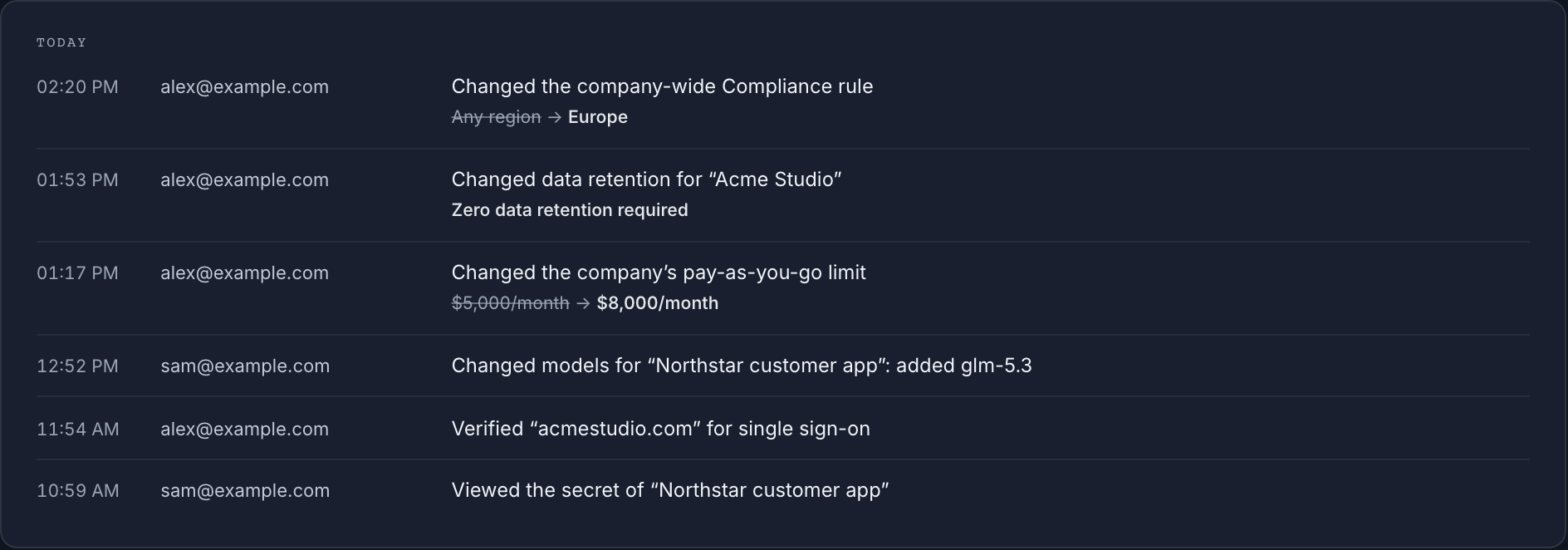
A record of changes and requests
Every admin change is recorded with before and after values, and you can export a record of every request showing the model, the provider that served it and the region rule in force, kept for 12 months. Records hold metadata only, never your prompts or outputs.
Questions from IT, data protection and security
- Does the DPC ban LLMs or AI assistants at work?
- No. The DPC's guidance bans no tool. It asks organisations to understand the data flows, the provider's retention and re-use, people's rights and the need for human review before they rely on an AI product.
- Is OpenRouter safe for an Irish company under the GDPR?
- That depends on the providers your requests reach and the terms you hold with each. The DPC's questions apply to any router or API: where does each request go, does the provider keep or re-use the data, and can you answer access and deletion requests. With Standard Compute you can restrict every request to approved European endpoints with zero data retention, under a DPA you sign in the dashboard.
- Can we run Claude in Ireland?
- Under a Europe rule, Claude is served in Europe on Google Vertex AI and on Amazon Bedrock in Ireland. Retries and fallbacks stay on approved European endpoints, and a request no European endpoint can serve is refused before your prompt is sent.
- Does Standard Compute keep the content of requests?
- We process your prompts in memory to serve each request and never write them to storage or logs. Request records hold metadata only: model, provider, tokens, cost and status.
Official sources
Summary based on these DPC documents, read on 18 November 2026. It replaces neither the documents themselves nor legal advice.
- AI, Large Language Models and Data Protection (Data Protection Commission, 18 July 2024)
- Data Protection Commission publishes AI Insights Report (Data Protection Commission, 25 September 2026) · PDF
Related
Create a company workspace, turn on the Europe rule and zero data retention, and give every AI use its own key.