Using ChatGPT, Claude or Copilot in a UK company: the ICO's guidance as a checklist
Updated 18 November 2026
The Information Commissioner's Office has no separate rulebook for AI tools at work. Its position is that data protection law applies in full: there is no AI exemption. For a UK company that puts customer or staff data into an AI assistant or an LLM API, the ICO's guidance comes down to six things: a DPIA before you start, clear controller and processor roles with the provider, a lawful basis and transparency, human review where decisions affect people, a lawful route for any transfer outside the UK, and evidence that you checked all of it.
Create a company workspaceTalk to usor write to contact@standardcompute.com
This page summarizes the ICO's published guidance with links to each page, turns it into tasks for a company and the controls that answer them, and shows the technical part an AI gateway handles. It summarizes public guidance and is not legal advice.
What does the ICO expect, in short?
- Does a UK company need a DPIA before using AI tools?
- Usually, yes. The ICO's guidance on AI and data protection says that in the vast majority of cases the use of AI involves processing likely to result in a high risk to people's rights and freedoms, which triggers the legal requirement to carry out a data protection impact assessment. Do it before the tool sees personal data.
- Is the AI provider our processor?
- Not automatically. The ICO says the contract does not decide whether an organisation is a controller, joint controller or processor; the practical reality of the processing does. For closed-access models it considers it unlikely that the developer can claim to be only a processor at deployment, so joint controllership is more likely. A provider that uses your data to improve its own models is a controller for that processing.
- What changed with the Data (Use and Access) Act 2025?
- The changes were phased in between June 2025 and June 2026. Significant automated decisions can now rest on the full range of lawful bases, with safeguards, except for special category data. You must help people make data protection complaints, acknowledge them within 30 days and respond without undue delay. The international transfer test was reworded: protection after transfer must not be materially lower.
What does the ICO's core AI guidance require?
Guidance on AI and data protection, ICO, last updated 15 March 2023, under review after the DUAA
- The guidance applies the UK GDPR principles to AI: accountability and governance, transparency, lawfulness, accuracy, fairness, security and data minimisation, and individual rights.
- Accountability stays with the controller, your organisation. Senior management, including DPOs, are accountable for understanding and addressing the risks.
- A DPIA is the key accountability tool and not a box-ticking exercise. In the vast majority of cases the use of AI will trigger the legal requirement to carry one out.
- Identifying and understanding controller and processor relationships is part of the accountability work.
- The ICO states that, because of the Data (Use and Access) Act, this guidance is under review and may change.
The accountability chapter: What are the accountability and governance implications of AI?, read on 18 November 2026.
What did the ICO conclude about generative AI?
Response to the consultation series on generative AI, ICO, 2024
- There is no 'AI exemption' to data protection law. If an organisation processes personal data, the law applies, and the ICO encourages a data protection by design approach before processing starts.
- 'Personally identifiable information' is narrower than the legal definition of personal data. Compliance work built around PII alone misses what UK law covers.
- Processing personal data incidentally or unintentionally is still processing.
- Contracts do not decide who is controller or processor; the actual control and influence over each processing activity does.
- For closed-access models, developers are unlikely to be processors at the deployment stage, and joint controllership is more likely. A joint controllership agreement sets out what each party is responsible for.
- A developer that processes a client's data to improve its own models is a controller for that processing, even if the client also benefits.
What does the ICO say about AI agents?
The ICO's call for evidence on agentic AI, ICO, 2026, building on the Tech Futures report of January 2026
- Organisations remain responsible for the data protection compliance of the agentic AI they develop, deploy or integrate into their systems and processes.
- Poorly implemented agents raise the risk of harm: systems with no clear purposes, connected to databases they don't need, or with no measures to secure access, monitor or stop activity, or control further sharing of information.
- Risks the ICO lists include unclear controller and processor roles across the agent supply chain, more automated decision-making, purposes set too broadly, processing beyond what a task needs, and new security threats.
- The call for evidence covers six themes: data security, transparency in agent supply chains, accountability, where the UK GDPR automated decision-making provisions apply, fairness and purpose limitation, and lawful processing.
- The evidence will inform ICO guidance on agentic AI and its statutory code of practice on AI and automated decision-making.
What does the Data (Use and Access) Act 2025 change for a company using AI?
The Data (Use and Access) Act 2025 (DUAA): what does it mean for organisations?, ICO, latest update 19 June 2026
- The DUAA amends the UK GDPR, the Data Protection Act 2018 and PECR; it does not replace them. The changes were phased in between June 2025 and June 2026.
- Automated decision-making: significant automated decisions can rely on the full range of lawful bases, potentially including legitimate interests, as long as appropriate safeguards apply. This does not extend to special category data.
- Complaints: you must help people who want to complain about how you use their personal information, for example with an electronic form, acknowledge complaints within 30 days and respond without undue delay.
- Subject access requests: searches only have to be reasonable and proportionate.
- International transfers: the test you apply when transferring personal information outside the UK has been reworded.
When is sending prompts to an AI provider outside the UK a restricted transfer?
A brief guide to international transfers, ICO, last updated 15 January 2026
- The three-step test: the UK GDPR applies to the data, you initiate the transfer to an organisation outside the UK, and the receiver is a separate legal entity. Three yes answers make it a restricted transfer.
- Every restricted transfer must be covered by UK adequacy regulations, appropriate safeguards, or an exception.
- The EEA countries, including Ireland, Germany and Finland, are covered by full UK adequacy regulations. The US is covered only for businesses certified under the UK Extension to the EU-US Data Privacy Framework.
- With a safeguard such as the IDTA or the Addendum to the EU standard contractual clauses, you also complete a transfer risk assessment to show protection is not materially lower after the transfer.
On the IDTA and Addendum page the ICO says it plans to update both in the course of 2026 and that organisations should keep using the current versions (read on 18 November 2026).
What does the ICO's guidance mean for a company, and which controls answer it?
A practical reading of the guidance for a UK company rolling out AI assistants, LLM APIs or agents: each task, what it requires of the organisation, and the controls that make it possible.
A DPIA per use
Assess each AI use before personal data goes in, with the DPO involved. Control: a register of AI uses and a separate key for each app, so it is clear what uses which model and provider.
Roles with each provider
Decide, on the facts, whether each AI provider is your processor or a joint or separate controller, and document it. Control: a provider that does not use your data for its own purposes, and a DPA that says so.
Lawful basis and transparency
A lawful basis for each use and privacy notices that explain the AI processing. Control: an updated record of processing activities and notices.
Human review and ADM
Where outputs lead to significant decisions about people, apply the DUAA safeguards, and keep special category data out of solely automated decisions. Control: a process description and staff instructions.
Transfers
Map where prompts go. Use adequacy where it applies; otherwise the IDTA or the Addendum with a transfer risk assessment. Control: a restriction on where requests are processed and a published sub-processor list.
No training, defined retention
Confirm the provider does not train on your data and know how long it keeps prompts and outputs. Control: zero data retention at the inference provider and a contract clause.
Agents with limits
Give each agent a clear purpose, only the data and tools it needs, and a way to monitor and stop it. Control: per-agent keys with their own models, budget and provider list.
Access and breaches
Named accounts with work sign-in, access only for those who need it, and an owner for breach reporting. Control: single sign-on with your identity provider and a breach procedure.
Complaints and evidence
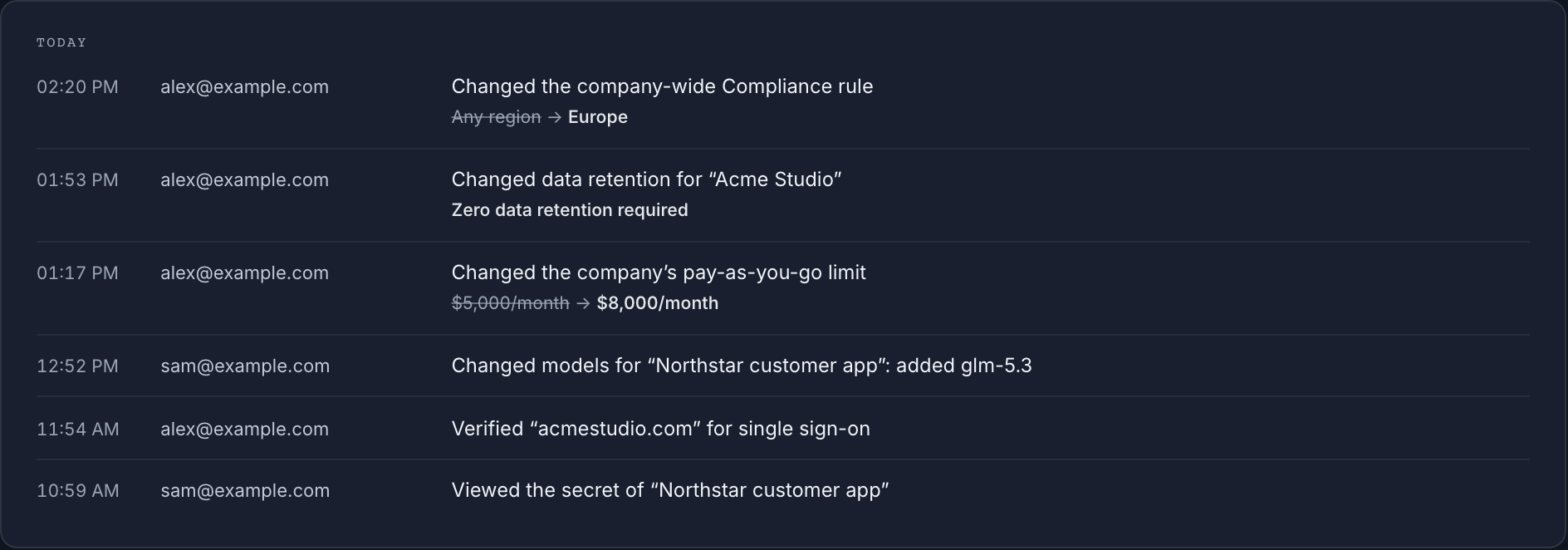
A way for people to complain, acknowledged within 30 days, and records that show what you checked. Control: a complaints route and an audit log of configuration changes.
Which part does an AI gateway handle?
The DPIA, lawful basis, notices, complaints handling and human review remain the company's work. Standard Compute, an AI gateway to frontier and open-source models, answers the technical part: where prompts go, who keeps them, which providers and models each key may use, who has access, and what record remains.
A DPA you can sign
Sign our Data Processing Agreement in the dashboard in minutes. It commits us to no training on your data, no retention of your content, and breach notification within 72 hours. Transfers to a country without adequacy are covered by the EU Standard Contractual Clauses and, for UK data, the UK International Data Transfer Addendum. We publish every sub-processor with its purpose, data and location, and give you 14 days' notice before adding a new one.
Where data is processed
Set a Europe rule for your company, a team or a single key, and every request, including retries and fallbacks, is served only by approved European inference endpoints. If no European endpoint can serve it, the request is refused before your prompt is sent. Europe here means the EU/EEA, the UK and Switzerland, all covered by UK adequacy regulations. Our EU gateway terminates TLS and runs in Finland, and your account data is stored in Frankfurt.
No training, no retention
Turn on zero data retention for your company, a team or a key, and every request is routed only to inference endpoints that commit to keeping no copy of your data. We process your prompts in memory to serve each request and never write them to storage or logs, and Standard Compute never trains on your prompts or outputs.
Approved providers and models
Choose exactly which inference providers may handle your data, for the whole company, a team or a single key. Lower levels can only narrow the rules, new providers are never added without an admin's approval, and fallbacks can never route around your list. Decide which models each key can use.
A key and a budget per use
Organize your company into teams and give every person and every app its own key. Every key gets a fixed monthly budget that never overruns, and you can set spending caps per key and for the whole company.
Work-account access
Connect Microsoft Entra ID or any SAML identity provider so your people sign in to Standard Compute with their work accounts. Employees sign in to Claude Desktop and Claude Code with their Microsoft work account, through our EU gateway, so there are no API keys to hand out, and access follows your Microsoft Entra groups through SCIM provisioning.
A record of changes and requests
Every admin change is recorded with before and after values, and you can export a record of every request showing the model, the provider that served it and the region rule in force, kept for 12 months. Records hold metadata only, never your prompts or outputs.
Questions from IT, data protection and security
- Does the ICO ban ChatGPT, Claude or Copilot at work?
- No. The ICO's guidance bans no tool. It sets out what data protection law requires when a tool processes personal data: a DPIA, clear roles, a lawful basis, transparency, security and a lawful route for transfers.
- Do we need an IDTA to use an LLM API from the UK?
- Not for recipients in a country covered by UK adequacy regulations, which include every EEA country. For a recipient elsewhere without adequacy, you need a safeguard such as the IDTA or the Addendum to the EU standard contractual clauses, plus a transfer risk assessment. Our DPA uses the EU Standard Contractual Clauses with the UK Addendum for transfers to countries without adequacy.
- Does an AI gateway make a UK company UK GDPR compliant?
- No. A gateway handles a technical part: where data is processed, retention, approved providers and models, budgets, access and logs. The DPIA, lawful basis, privacy notices, complaints handling and human review remain the company's responsibility.
- Can we keep AI processing in the UK only?
- With Standard Compute, the Europe rule keeps inference on approved endpoints in Europe, which covers the EU/EEA, the UK and Switzerland. There is no UK-only region. UK adequacy regulations cover the EEA, so Europe-rule inference in the EEA needs no extra transfer safeguard.
- Does Standard Compute keep the content of requests?
- We process your prompts in memory to serve each request and never write them to storage or logs. Request records hold metadata only: model, provider, tokens, cost and status.
Official sources
Summary based on these ICO pages, read on 18 November 2026. It replaces neither the guidance itself nor legal advice.
- Guidance on AI and data protection (ICO, last updated 15 March 2023, under review after the DUAA)
- Response to the consultation series on generative AI (ICO, 2024)
- The ICO's call for evidence on agentic AI (ICO, 2026, building on the Tech Futures report of January 2026)
- The Data (Use and Access) Act 2025 (DUAA): what does it mean for organisations? (ICO, latest update 19 June 2026)
- A brief guide to international transfers (ICO, last updated 15 January 2026)
Related
Create a company workspace, turn on the Europe rule and zero data retention, and give every AI use its own key.