Why companies look for an alternative to LiteLLM
From LiteLLM’s own pricing and documentation, checked 7 November 2026:
- You operate it: the proxy needs Postgres, which is required for the proxy's auth and tracking features, and Redis, which is required once you run more than one instance. Production guidance is one worker per pod, 1 vCPU and 4Gi of memory per pod, scaled horizontally.
- SSO has a seat ceiling: SSO is free for up to 5 users; beyond that, an Enterprise license is required.
- Governance is in the paid tier: audit logs, secret managers, key rotation and guardrails per key or team are Enterprise features, and Enterprise pricing depends on your deployment size with no published price.
- Every provider is your own contract: models are configured with your own provider keys, for example
api_key: os.environ/ANTHROPIC_API_KEYin the config, so each vendor's DPA, retention terms and quota are yours to negotiate. - Spend logs are kept until you set a limit: log retention defaults to null, cleanup disabled.
What Standard Compute does differently
A single API gives you frontier and open-source models, and it routes each step to the cheapest model that can do it and the cheapest provider fast enough to serve it.
With LiteLLM you write the routing rules and pay each provider's list price. On Standard Compute the router picks the model for each step and the cheapest provider that meets the latency and tokens-per-second bar, and you pay a flat monthly plan per person or app, with no per-token surprises. The hours your platform team spends on upgrades, Postgres and Redis go back to product work.
Control is set once for the company:
Processing in Europe
Set a Europe rule for your company, a team or a single key, and every request, including retries and fallbacks, is served only by approved European inference endpoints. If no European endpoint can serve it, the request is refused before your prompt is sent. Our EU gateway terminates TLS and runs in Finland, and your account data is stored in Frankfurt.
Zero data retention
Turn on zero data retention for your company, a team or a key, and every request is routed only to inference endpoints that commit to keeping no copy of your data. Teams and keys inherit the requirement and can never switch it off underneath you.
No training
Standard Compute never trains on your prompts or outputs. With a region rule or zero retention turned on, every request goes only to providers that commit not to train on it.
Single sign-on
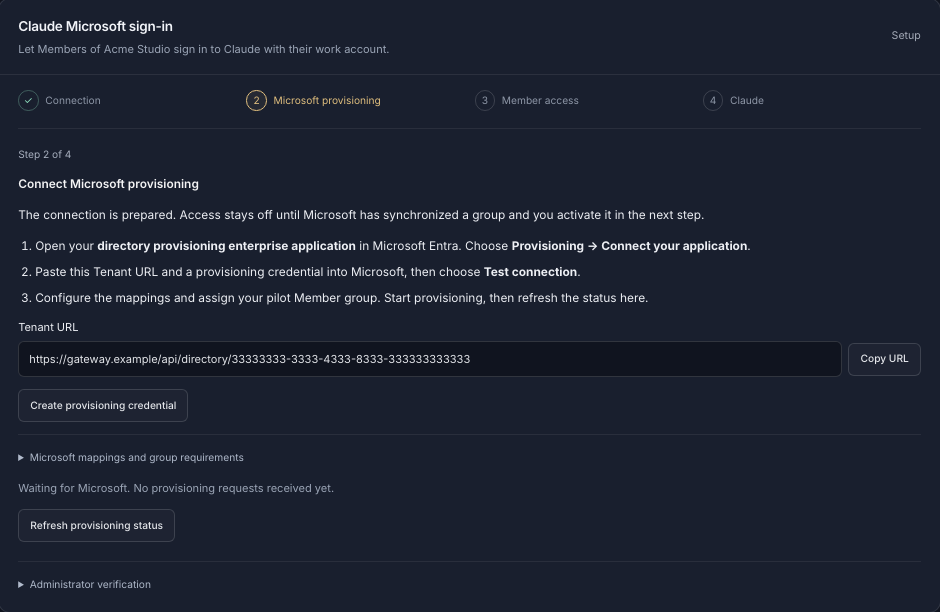
Connect Microsoft Entra ID or any SAML identity provider so your people sign in with their work accounts. Employees sign in to Claude Desktop and Claude Code with their Microsoft work account through our EU gateway, and access follows your Entra groups through SCIM provisioning.
Teams and keys
Organize your company into teams, invite colleagues by email, and give every person and every app its own key, all under one company account.
Budgets
Every person and app gets a fixed monthly budget that never overruns, and you can set spending caps per key and for the whole company. Optional top-off from a prepaid company balance keeps critical agents running.
Allow-lists
Choose exactly which inference providers may handle your data, for the whole company, a team or a single key. New providers are never added without an admin's approval, and fallbacks can never route around your list. Decide which models each key can use.
Audit
Every admin change is recorded with before and after values, and you can export a record of every request showing the model, the provider that served it and the region rule in force, kept for 12 months.
Contract
Sign our Data Processing Agreement in the dashboard. It commits us to no training on your data, no retention of your content, and breach notification within 72 hours. We publish every sub-processor and give you 14 days' notice before adding a new one.
Standard Compute and LiteLLM compared
| Standard Compute | LiteLLM | |
|---|---|---|
| Pricing | Flat monthly plan per person or app with no per-token surprises; Stripe invoices with your company name and VAT number | Open source is free; Enterprise license priced by deployment size, no published price; each model provider billed separately |
| Cost routing | Each step goes to the cheapest model that can do it and the cheapest provider fast enough to serve it | Routing and fallbacks you configure |
| Models | Claude, GPT, Gemini and open models (GLM, DeepSeek, MiniMax, Kimi) through one API | Any provider you hold a key for |
| Processing in Europe | Europe rule per company, team or key; retries and fallbacks stay on approved European endpoints; refused before sending if none qualifies | Where you host the proxy; model processing depends on each provider account you connect |
| Zero data retention | Per company, team or key; lower levels cannot switch it off | Depends on each provider contract; prompts are not stored in spend logs by default |
| Training on your data | Never trains on prompts or outputs | Depends on each provider contract |
| Single sign-on | SAML SSO, Microsoft Entra ID included; Claude Desktop and Claude Code sign-in with a Microsoft work account, SCIM from Entra | Free for up to 5 users; Enterprise license beyond that |
| Teams and keys | Teams, roles, a key per person and per app | Virtual keys, users and teams in open source |
| Spend limits | Fixed monthly budget per key; requests are refused once it is used; caps per key and per company | Budgets per key, user, team and customer; tag and model budgets on Enterprise |
| Provider and model allow-lists | Provider allow-list per company, team or key; new providers need an admin; models chosen per key | The models you put in the config; guardrails per key or team on Enterprise |
| Audit log | Admin log with before and after values; request export with model, provider and region rule, kept 12 months | Audit logs on Enterprise |
| DPA | Signed in the dashboard | With each model provider you connect |
| What you operate | Managed service; nothing to host | Docker or Kubernetes, Postgres, and Redis once you run more than one instance |
When LiteLLM fits
LiteLLM fits when policy requires the gateway itself to run inside your own network and a platform team is staffed to operate it.
Moving from LiteLLM to Standard Compute
Standard Compute’s API runs on stdcmpt.com. https://eu.stdcmpt.com is our EU gateway in Finland.
Two ways to move. Replace the proxy, or keep LiteLLM for a while and add Standard Compute as its upstream, so applications keep their current endpoint while you move teams over.
- Create a company workspace and set the rules once for the company: a Europe rule, zero data retention, and the providers and models you approve. Teams and keys inherit them.
- Recreate your LiteLLM virtual keys as Standard Compute keys, one per person and per app, each with its own monthly budget.
- Point clients at
https://eu.stdcmpt.com/v1instead ofhttp://0.0.0.0:4000, and Claude Code athttps://eu.stdcmpt.com. - Connect Microsoft Entra ID or your SAML identity provider so your people sign in with their work accounts, and set up Claude Desktop and Claude Code sign-in with Microsoft work accounts.
- When the last team has moved, retire the proxy, its Postgres database and Redis.
model_list:
  - model_name: claude-sonnet
    litellm_params:
      model: openai/anthropic/claude-sonnet-5.5
      api_base: https://eu.stdcmpt.com/v1
      api_key: os.environ/STANDARD_COMPUTE_API_KEY
  - model_name: auto
    litellm_params:
      model: openai/standardcompute
      api_base: https://eu.stdcmpt.com/v1
api_key: os.environ/STANDARD_COMPUTE_API_KEYfrom openai import OpenAI
client = OpenAI(
base_url="https://eu.stdcmpt.com/v1",
api_key=os.environ["STANDARD_COMPUTE_API_KEY"],
)
# "standardcompute" sends each step to the cheapest
# model that can do it. Or pin a model:
# model="anthropic/claude-sonnet-5.5"
client.chat.completions.create(
model="standardcompute",
messages=messages,
)# Claude Code adds /v1/messages itself
export ANTHROPIC_BASE_URL=https://eu.stdcmpt.com
export ANTHROPIC_AUTH_TOKEN=YOUR_STANDARD_COMPUTE_KEY
claudeQuestions
Self-hosting the LiteLLM proxy is becoming a pain. What managed alternative has SSO and budgets?
Standard Compute is a managed gateway with nothing to host: Microsoft Entra ID or SAML SSO, a key per person and per app with a fixed monthly budget, provider allow-lists and an audit log, all set in the dashboard.
Do we need a contract with every model provider?
No. One Standard Compute account gives you Claude, GPT, Gemini and open models through one API, under one DPA you sign in the dashboard.
Can we keep LiteLLM and use Standard Compute behind it?
Yes. Standard Compute is OpenAI-compatible, so you can add it to the LiteLLM model_list with api_base https://eu.stdcmpt.com/v1 and move teams over one at a time.
Can we keep processing in Europe without hosting the gateway ourselves?
With a Europe rule on your company, a team or a key, every request, including retries and fallbacks, is served only by approved European inference endpoints, and a request no European endpoint can serve is refused before your prompt is sent.
Does Standard Compute have audit logs?
Every admin change is recorded with before and after values, and you can export a record of every request showing the model, the provider that served it and the region rule in force, kept for 12 months.
Set up your company
Create a company workspace, invite your team and set your rules from the dashboard. Security questionnaires and procurement questions go to contact@standardcompute.com.
Create a company workspaceor write to contact@standardcompute.com
Sources (checked 7 November 2026)
- LiteLLM Enterprisedocs.litellm.ai
- LiteLLM pricingwww.litellm.ai
- Deploy the proxydocs.litellm.ai
- Production best practicesdocs.litellm.ai
- Users, teams and budgetsdocs.litellm.ai
- Config settingsdocs.litellm.ai
- Proxy quick startdocs.litellm.ai
- Claude Code with LiteLLMdocs.litellm.ai