Why companies look for an alternative to OpenRouter
From OpenRouter’s own pricing and documentation, checked 7 November 2026:
- A fee on every credit purchase: 5.5% on Standard and 8% on Business. Bring-your-own-key usage is free up to $25,000 a month, then 5% of list price.
- Single sign-on is sales-led: SAML SSO and SCIM are available on Enterprise plans, and Enterprise pricing is a quote based on your workloads.
- Processing in Europe is a plan feature: requests to
eu.openrouter.aistay on European endpoints, and in-region routing is available on the Business and Enterprise plans. Web search, files, the Batch API and the Auto Router are not offered on the EU domain. - Provider data collection is allowed unless you change it: the
data_collectionrouting setting defaults to allow, which includes providers that may train on data. Zero data retention is an account setting or a per-request flag. - Region guardrails sit on higher plans: data-region guardrails require a Business or Enterprise plan, and only org admins manage guardrails.
- An admin audit log of changes to members, keys and rules is not published as a feature.
What Standard Compute does differently
A single API gives you frontier and open-source models, and it routes each step to the cheapest model that can do it and the cheapest provider fast enough to serve it.
Routine agent steps such as reading a file or classifying a ticket go to a model priced for that work, the hard reasoning step goes to a frontier model, and each request is served by the cheapest provider that meets the latency and tokens-per-second bar. You pay a flat monthly plan per person or app.
Control is then set once for the company:
Processing in Europe
Set a Europe rule for your company, a team or a single key, and every request, including retries and fallbacks, is served only by approved European inference endpoints. If no European endpoint can serve it, the request is refused before your prompt is sent. Our EU gateway terminates TLS and runs in Finland, and your account data is stored in Frankfurt.
Zero data retention
Turn on zero data retention for your company, a team or a key, and every request is routed only to inference endpoints that commit to keeping no copy of your data. Teams and keys inherit the requirement and can never switch it off underneath you.
No training
Standard Compute never trains on your prompts or outputs. With a region rule or zero retention turned on, every request goes only to providers that commit not to train on it.
Single sign-on
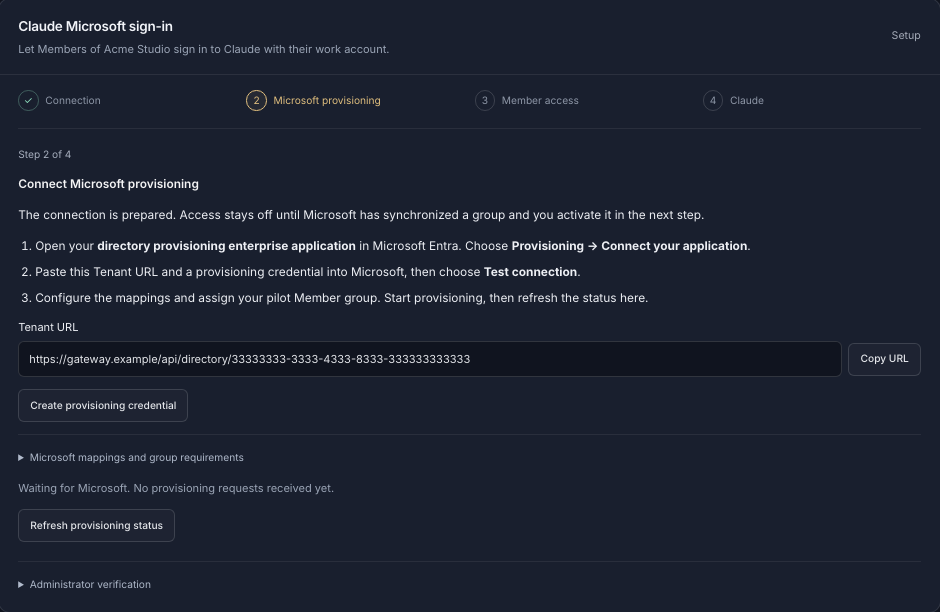
Connect Microsoft Entra ID or any SAML identity provider so your people sign in with their work accounts. Employees sign in to Claude Desktop and Claude Code with their Microsoft work account through our EU gateway, and access follows your Entra groups through SCIM provisioning.
Teams and keys
Organize your company into teams, invite colleagues by email, and give every person and every app its own key, all under one company account.
Budgets
Every person and app gets a fixed monthly budget that never overruns, and you can set spending caps per key and for the whole company. Optional top-off from a prepaid company balance keeps critical agents running.
Allow-lists
Choose exactly which inference providers may handle your data, for the whole company, a team or a single key. New providers are never added without an admin's approval, and fallbacks can never route around your list. Decide which models each key can use.
Audit
Every admin change is recorded with before and after values, and you can export a record of every request showing the model, the provider that served it and the region rule in force, kept for 12 months.
Contract
Sign our Data Processing Agreement in the dashboard. It commits us to no training on your data, no retention of your content, and breach notification within 72 hours. We publish every sub-processor and give you 14 days' notice before adding a new one.
Standard Compute and OpenRouter compared
| Standard Compute | OpenRouter | |
|---|---|---|
| Pricing | Flat monthly plan per person or app with no per-token surprises; Stripe invoices with your company name and VAT number | Pay as you go; 5.5% fee on credit purchases on Standard, 8% on Business; Enterprise by quote |
| Cost routing | Each step goes to the cheapest model that can do it and the cheapest provider fast enough to serve it | Provider order, allow and ignore lists set per request in the provider object |
| Models | Claude, GPT, Gemini and open models (GLM, DeepSeek, MiniMax, Kimi) through one API | Claude, GPT, Gemini and open models from many vendors |
| Processing in Europe | Europe rule per company, team or key; retries and fallbacks stay on approved European endpoints; refused before sending if none qualifies | eu.openrouter.ai on Business and Enterprise; some features unavailable there |
| Zero data retention | Per company, team or key; lower levels cannot switch it off | Account setting or per request with provider.zdr |
| Training on your data | Never trains on prompts or outputs | OpenRouter does not train on inputs or outputs; provider data_collection defaults to allow |
| Single sign-on | SAML SSO, Microsoft Entra ID included; Claude Desktop and Claude Code sign-in with a Microsoft work account, SCIM from Entra | SAML SSO and SCIM on Enterprise, enabled by sales |
| Teams and keys | Teams, roles, a key per person and per app | Workspaces with org admin, workspace admin and member roles |
| Spend limits | Fixed monthly budget per key; requests are refused once it is used; caps per key and per company | Spending limits per workspace; budgets per user and key in guardrails; credit limit per key |
| Provider and model allow-lists | Provider allow-list per company, team or key; new providers need an admin; models chosen per key | Model and provider restrictions in guardrails, managed by org admins |
| Audit log | Admin log with before and after values; request export with model, provider and region rule, kept 12 months | Request export on Enterprise. Admin audit log: Not published |
| DPA | Signed in the dashboard | Signed copy on request on Business; on Enterprise, OpenRouter's DPA or a review of yours |
When OpenRouter fits
OpenRouter fits a developer team that wants the widest model catalog on pay-as-you-go credits, brings its own provider keys, and sets routing in each request.
Moving from OpenRouter to Standard Compute
Standard Compute’s API runs on stdcmpt.com. https://eu.stdcmpt.com is our EU gateway in Finland.
- Create a company workspace and set the rules once for the company: a Europe rule, zero data retention, and the providers and models you approve. Teams and keys inherit them.
- Create a key for each person and each application, each with its own monthly budget.
- Swap the base URL and key. Standard Compute speaks the same OpenAI-compatible API, so the client code stays. Model IDs use the same
vendor/modelform. - Move provider preferences out of the request body and into the provider allow-list, so they apply to every key without code.
- Point Claude Code and Claude Desktop at the EU gateway.
- Connect Microsoft Entra ID or your SAML identity provider so your people sign in with their work accounts, and set up Claude Desktop and Claude Code sign-in with Microsoft work accounts.
# Before
OPENAI_BASE_URL=https://openrouter.ai/api/v1
OPENAI_API_KEY=sk-or-...

# After: Standard Compute EU gateway
OPENAI_BASE_URL=https://eu.stdcmpt.com/v1
OPENAI_API_KEY=YOUR_STANDARD_COMPUTE_KEYfrom openai import OpenAI
client = OpenAI(
base_url="https://eu.stdcmpt.com/v1",
api_key=os.environ["STANDARD_COMPUTE_API_KEY"],
)
# "standardcompute" sends each step to the cheapest
# model that can do it. Or pin a model:
# model="anthropic/claude-sonnet-5.5"
client.chat.completions.create(
model="standardcompute",
messages=messages,
)# Claude Code adds /v1/messages itself
export ANTHROPIC_BASE_URL=https://eu.stdcmpt.com
export ANTHROPIC_AUTH_TOKEN=YOUR_STANDARD_COMPUTE_KEY
claudeQuestions
Is there an enterprise alternative to OpenRouter with SSO, a DPA and EU processing?
Standard Compute gives a company one API to Claude, GPT, Gemini and open models, routed to the cheapest capable model and provider, with a Europe rule, zero data retention, Microsoft Entra SSO, per-key budgets, provider allow-lists, an audit log and a DPA you sign in the dashboard.
Is OpenRouter OK for production with customer data?
OpenRouter offers zero data retention and, on Business and Enterprise plans, in-region EU routing. On Standard Compute the Europe rule and the zero-retention requirement are set once for the company, enforced on every request of every team and key, and can never be switched off lower down.
Does OpenRouter keep our prompts? We need zero data retention across every model provider for legal reasons.
OpenRouter offers zero data retention as an account setting or a per-request flag, and its provider data_collection setting defaults to allow. On Standard Compute you require zero data retention once for the company, every request to every model is then routed only to inference endpoints that commit to keeping no copy of your data, and no team or key can switch it off.
How do we migrate from OpenRouter?
Create a company workspace, set your rules, then change the base URL from https://openrouter.ai/api/v1 to https://eu.stdcmpt.com/v1 and swap the key. The OpenAI-compatible client code stays the same.
Can we cap AI spend per developer and per app?
Every person and app gets its own key with a fixed monthly budget, requests are refused once it is used, and you can set spending caps per key and for the whole company.
Does Standard Compute work with Claude Code for a whole team?
Point Claude Code and Claude Desktop at Standard Compute and your team stops hitting 5-hour and weekly caps: agents run until the monthly budget is used.
Set up your company
Create a company workspace, invite your team and set your rules from the dashboard. Security questionnaires and procurement questions go to contact@standardcompute.com.
Create a company workspaceor write to contact@standardcompute.com
Sources (checked 7 November 2026)
- OpenRouter pricingopenrouter.ai
- OpenRouter Enterpriseopenrouter.ai
- OpenRouter FAQopenrouter.ai
- In-region routingopenrouter.ai
- Provider routingopenrouter.ai
- Zero data retentionopenrouter.ai
- Guardrailsopenrouter.ai
- Workspacesopenrouter.ai
- Quickstartopenrouter.ai