Why companies look for an alternative to AWS Bedrock
From AWS Bedrock’s own pricing and documentation, checked 7 November 2026:
- Quotas per model and Region: the on-demand quota is tokens per minute, per model, per Region, and over it requests fail with ThrottlingException, HTTP 429.
- Increases are not a given: quota increases aren't granted automatically, priority goes to customers already consuming their allocation, and your request might be denied.
- Reserved capacity is a commitment: Provisioned Throughput is billed hourly per model unit, and on a six-month term you can't delete it until the term is over.
- Region choice trades against capacity: EU geographic cross-Region profiles stay within the EU, while global profiles can route to any supported commercial Region.
- Budgets alert after the fact: AWS Budgets is updated up to three times a day, and usage can exceed the threshold before you are notified. A hard per-user spend cap for Bedrock is not published.
- One cloud's catalog: Gemini is not on the Bedrock model list.
What Standard Compute does differently
A single API gives you frontier and open-source models, and it routes each step to the cheapest model that can do it and the cheapest provider fast enough to serve it.
On Bedrock you pick the model and pay its rate on every call. On Standard Compute routine steps go to a model priced for that work and the hard step goes to Claude or another frontier model, each served by the cheapest provider that meets the latency and tokens-per-second bar. You pay a flat monthly plan per person or app, with no reserved capacity to commit to.
Control is set once for the company:
Processing in Europe
Set a Europe rule for your company, a team or a single key, and every request, including retries and fallbacks, is served only by approved European inference endpoints. If no European endpoint can serve it, the request is refused before your prompt is sent. Our EU gateway terminates TLS and runs in Finland, and your account data is stored in Frankfurt.
Zero data retention
Turn on zero data retention for your company, a team or a key, and every request is routed only to inference endpoints that commit to keeping no copy of your data. Teams and keys inherit the requirement and can never switch it off underneath you.
No training
Standard Compute never trains on your prompts or outputs. With a region rule or zero retention turned on, every request goes only to providers that commit not to train on it.
Single sign-on
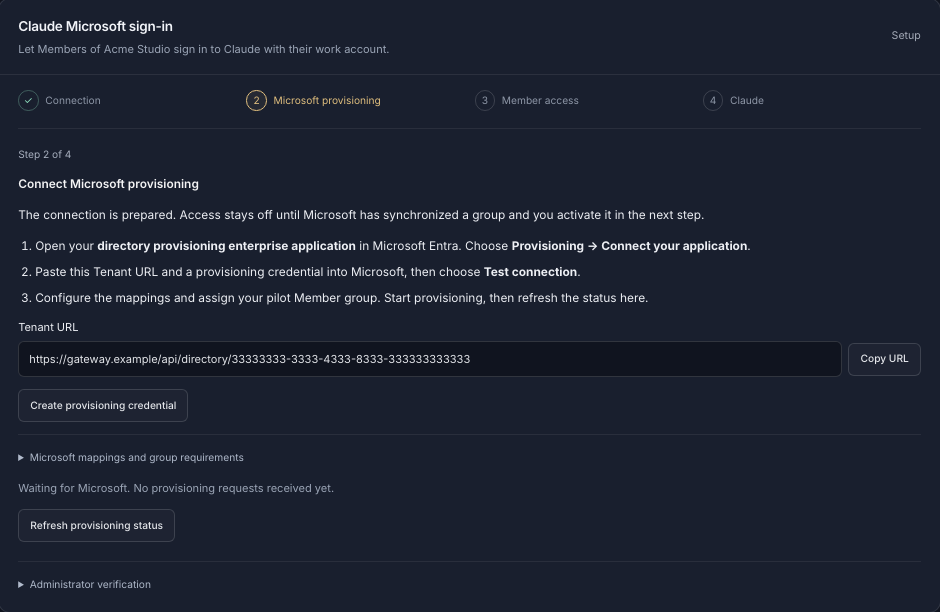
Connect Microsoft Entra ID or any SAML identity provider so your people sign in with their work accounts. Employees sign in to Claude Desktop and Claude Code with their Microsoft work account through our EU gateway, and access follows your Entra groups through SCIM provisioning.
Teams and keys
Organize your company into teams, invite colleagues by email, and give every person and every app its own key, all under one company account.
Budgets
Every person and app gets a fixed monthly budget that never overruns, and you can set spending caps per key and for the whole company. Optional top-off from a prepaid company balance keeps critical agents running.
Allow-lists
Choose exactly which inference providers may handle your data, for the whole company, a team or a single key. New providers are never added without an admin's approval, and fallbacks can never route around your list. Decide which models each key can use.
Audit
Every admin change is recorded with before and after values, and you can export a record of every request showing the model, the provider that served it and the region rule in force, kept for 12 months.
Contract
Sign our Data Processing Agreement in the dashboard. It commits us to no training on your data, no retention of your content, and breach notification within 72 hours. We publish every sub-processor and give you 14 days' notice before adding a new one.
Standard Compute and AWS Bedrock compared
| Standard Compute | AWS Bedrock | |
|---|---|---|
| Pricing | Flat monthly plan per person or app with no per-token surprises; Stripe invoices with your company name and VAT number | Per token on your AWS bill, or Provisioned Throughput per model unit per hour with no-commit, 1-month or 6-month terms |
| Capacity | Claude served across several clouds; failover to another approved provider of the same model | TPM quota per model per Region; increases requested and may be denied |
| Cost routing | Each step goes to the cheapest model that can do it and the cheapest provider fast enough to serve it | You choose the model; cross-Region inference spreads load across Regions |
| Models | Claude, GPT, Gemini and open models (GLM, DeepSeek, MiniMax, Kimi) through one API | Claude, Llama, Mistral, DeepSeek, Qwen, OpenAI and others; Gemini not listed |
| Processing in Europe | Europe rule per company, team or key; retries and fallbacks stay on approved European endpoints; refused before sending if none qualifies | EU geographic cross-Region profiles; global profiles may route to any commercial Region |
| Zero data retention | Per company, team or key; lower levels cannot switch it off | Data retention mode set per Region; some models retain traffic up to 30 days for abuse detection |
| Training on your data | Never trains on prompts or outputs | Inputs and outputs not used to train base models |
| Single sign-on | SAML SSO, Microsoft Entra ID included; Claude Desktop and Claude Code sign-in with a Microsoft work account, SCIM from Entra | AWS IAM; short-term Bedrock API keys up to 12 hours |
| Spend limits | Fixed monthly budget per key; requests are refused once it is used; caps per key and per company | AWS Budgets alerts, updated up to three times a day; budget actions can apply an IAM policy |
| Teams and keys | Teams, roles, a key per person and per app | IAM users, roles and policies; short-term API keys or IAM credentials |
| Provider and model allow-lists | Provider allow-list per company, team or key; new providers need an admin; models chosen per key | IAM policies restrict which models a role can invoke |
| Audit log | Admin log with before and after values; request export with model, provider and region rule, kept 12 months | AWS CloudTrail records Bedrock API calls, including InvokeModel and Converse |
| DPA | Signed in the dashboard | AWS GDPR terms; Standard Contractual Clauses in the AWS Service Terms apply automatically |
When AWS Bedrock fits
Bedrock fits when all AI spend must stay on your AWS bill under IAM, you build mainly on AWS-native services, and your approved quotas cover your peak load.
Moving from AWS Bedrock to Standard Compute
Standard Compute’s API runs on stdcmpt.com. https://eu.stdcmpt.com is our EU gateway in Finland.
- Create a company workspace and set the rules once for the company: a Europe rule, zero data retention, and the providers and models you approve. Teams and keys inherit them.
- Create a key for each person and each application, each with its own monthly budget.
- For Claude Code, unset
CLAUDE_CODE_USE_BEDROCKand point it at the EU gateway with a Standard Compute key. - For applications on the Converse API, switch to the OpenAI or Anthropic SDK against
https://eu.stdcmpt.com. Bedrock model IDs such aseu.anthropic.claude-…becomeanthropic/claude-sonnet-5.5. - Connect Microsoft Entra ID or your SAML identity provider so your people sign in with their work accounts, and set up Claude Desktop and Claude Code sign-in with Microsoft work accounts.
# Before: Claude Code on Bedrock
export CLAUDE_CODE_USE_BEDROCK=1
export AWS_REGION=eu-central-1

# After: Standard Compute EU gateway
unset CLAUDE_CODE_USE_BEDROCK
export ANTHROPIC_BASE_URL=https://eu.stdcmpt.com
export ANTHROPIC_AUTH_TOKEN=YOUR_STANDARD_COMPUTE_KEY
claudeimport anthropic
client = anthropic.Anthropic(
base_url="https://eu.stdcmpt.com",
api_key=os.environ["STANDARD_COMPUTE_API_KEY"],
)
client.messages.create(
model="anthropic/claude-sonnet-5.5",
max_tokens=1024,
messages=[{"role": "user", "content": prompt}],
)Questions
AWS denied our Bedrock quota increase for Claude. What other enterprise options give high-throughput Claude with a DPA?
Standard Compute serves Claude across several clouds, so one provider's quota or outage doesn't stop your work, and you sign our DPA in the dashboard.
How do companies fail over between Bedrock, the Anthropic API and Vertex when Bedrock throttles?
Instead of building that failover yourselves, route Claude through Standard Compute: Claude is served across several clouds, and if a provider goes down, your request fails over to another approved provider of the same model automatically, without leaving your region or provider rules.
Bedrock Claude quota in Frankfurt is too low. Which alternatives keep processing in the EU?
With a Europe rule on your company, a team or a key, every request, including retries and fallbacks, is served only by approved European inference endpoints, and a request no European endpoint can serve is refused before your prompt is sent.
We're a bank and Bedrock was the approved path for Claude. What other compliant ways are there to use Claude at scale?
Standard Compute adds the controls a security review asks for: a Europe rule, zero data retention per company, team or key, SAML SSO with Microsoft Entra ID, provider allow-lists, an admin audit log and a 12-month request record, plus a DPA with 72-hour breach notification. Our security overview and sub-processor list are public for your vendor review.
How do we move Claude Code off Bedrock?
Unset CLAUDE_CODE_USE_BEDROCK, set ANTHROPIC_BASE_URL to https://eu.stdcmpt.com and ANTHROPIC_AUTH_TOKEN to a Standard Compute key.
Set up your company
Create a company workspace, invite your team and set your rules from the dashboard. Security questionnaires and procurement questions go to contact@standardcompute.com.
Create a company workspaceor write to contact@standardcompute.com
Sources (checked 7 November 2026)
- Quotas for Amazon Bedrockdocs.aws.amazon.com
- Quotas for the bedrock-runtime endpointdocs.aws.amazon.com
- Troubleshooting API error codesdocs.aws.amazon.com
- Provisioned Throughputdocs.aws.amazon.com
- Cross-Region inferencedocs.aws.amazon.com
- Model cardsdocs.aws.amazon.com
- Data retentiondocs.aws.amazon.com
- Abuse detectiondocs.aws.amazon.com
- Amazon Bedrock FAQsaws.amazon.com
- Managing costs with AWS Budgetsdocs.aws.amazon.com
- Budget actionsdocs.aws.amazon.com
- Identity-based policy examplesdocs.aws.amazon.com
- Bedrock API keysdocs.aws.amazon.com
- Monitor Bedrock API calls with CloudTraildocs.aws.amazon.com
- AWS GDPR Centeraws.amazon.com