AI at work: what Finland's Data Protection Ombudsman requires
Updated 9 November 2026
On 20 May 2025 the Office of the Data Protection Ombudsman in Finland published guidance on data protection in the development and use of AI systems. An organization must assess the data protection risks of an AI system before it starts processing personal data, needs a legal basis for using the system as well as for developing it, and must be able to show to what extent the AI made a decision about a person.
Create a company workspaceor write to contact@standardcompute.com
This page summarizes the guidance with links to the official sources, turns its requirements into tasks for a company and concrete controls, and shows the technical part an AI gateway handles. It summarizes public guidance and is not legal advice. Quotations come from the office's own English version.
What does the Ombudsman say, in short?
- What is the Finnish Data Protection Ombudsman's AI guidance?
- A web guide from the Office of the Data Protection Ombudsman, "Data protection in the development and use of AI systems", announced on 20 May 2025 and published in Finnish and English. It covers risk and impact assessment, legal bases, AI Act prohibited practices, data protection principles, automated decision-making, security, data subjects' rights and accountability. The office says it is not exhaustive and requirements must be assessed case by case.
- What must a company do before it starts using an AI system?
- Work out whether the system processes personal data, and know the system well enough to judge that. Assess the risks from the individuals' point of view before processing starts, fix the purpose in advance and choose a legal basis for the use. A DPIA is mandatory when the processing could cause a high risk or is on the Ombudsman's list of processing that requires one.
- What does the guidance require for security?
- Technical and organizational measures over the whole life cycle, for example encryption, access rights management, vulnerability testing, and log data and auditing. For AI specifically, inputs are checked for deviating or harmful content, and outputs are checked for accuracy, fairness and traceability.
What did the Ombudsman publish?
Guidelines published on ensuring data protection in the development and use of AI systems, Office of the Data Protection Ombudsman, 20 May 2025
- Organizations that process personal data in AI systems must comply with data protection law, and the EU AI Act also applies.
- An organization must assess the data protection risks of an AI system before it starts processing personal data, and decide on safeguards based on that assessment.
- A valid legal basis is needed for the processing, including when personal data is used to train AI.
- The guidance is not exhaustive and requirements must always be assessed case by case. The page is updated as needed.
What does the guidance require of an organization using AI?
Data protection in the development and use of AI systems, Office of the Data Protection Ombudsman, web guidance, published 20 May 2025
The guidance covers both development and use. The points that matter most for a company deploying AI, in the guide's order:
- "Data protection legislation must always be complied with if personal data is processed automatically." The organization has to establish whether the system processes personal data and know the system and how it works well enough.
- Risks are assessed from the individuals' point of view before processing starts. A DPIA is mandatory when the processing could cause a high risk or appears on the Ombudsman's list of processing operations that require one.
- A legal basis is needed for both development and use. The two phases are kept apart so each can have its own basis and risk management. Legitimate interest needs a three-step assessment, and special category data also needs an Article 9 exception.
- Article 5 of the AI Act prohibits certain uses outright, for example inferring emotions in the workplace and in education. High-risk systems may be used only if they meet the AI Act's requirements.
- Transparency and purpose: people are told what data is collected, why, for how long, whether it is shared with third parties and what their rights are. The purpose is fixed before processing starts, and data may not later be used for incompatible purposes.
- Minimization and retention: only the data needed, accuracy especially when data is used for decisions about people, and a time limit after which data is erased, archived or anonymized.
- Automated decisions: people are told the logic and consequences of the processing, and the organization "must also be able to demonstrate to what extent the AI system made the decision relating to them".
- Security: for example encryption, access rights management, vulnerability testing, and log data and auditing. Inputs are also checked for deviating or harmful content, and outputs for accuracy, fairness and traceability.
- Rights and accountability: the system must let people exercise access, rectification, erasure, restriction, objection and portability, and the organization must document its measures and be able to show that it complies.
What do the requirements mean for a company, and which controls meet them?
A practical reading for a company deploying AI: each requirement in the guidance, what it asks of the organization, and the controls that make it possible.
Find out whether personal data is involved
For each AI use, record what data goes into the system and how the system works. Control: a register of AI uses and a separate key for each app.
Risk assessment before go-live
Assess the risks from the individuals' point of view before processing starts, and run a DPIA when the high-risk criteria are met. Control: a documented risk assessment and DPIA.
Purpose and legal basis
Fix the purpose in advance and choose a basis for the use. Control: the record of processing activities and an AI usage policy.
Rule out prohibited practices
Check that the use is not prohibited under Article 5 of the AI Act, such as inferring emotions at work. Control: classification in the register of AI uses.
Transparency
Tell employees and customers what data the AI processes and what their rights are, and tell users when they are dealing with AI. Control: updated privacy notices.
Minimization and retention periods
Only necessary data goes into prompts, and retention has a time limit, at the provider too. Control: prompt rules and zero data retention with the inference provider.
A person behind the decision
Decisions about people don't rest solely on automated processing, and the AI's share in a decision can be shown. Control: a process description, human review and a request log showing the model used.
Security and access rights
Access only for those who need it, logs and auditing, input checks and output monitoring. Control: single sign-on with the company's identity provider, an admin audit log and a request log.
Rights and accountability
A process for data subject requests and documentation of the measures taken. Control: a data processing agreement with the provider and its sub-processor list.
Which part does an AI gateway handle?
The legal basis, risk assessment, DPIA, privacy notices and human review remain the company's work. Standard Compute, an AI gateway to frontier and open-source models, handles the model layer of the retention, security and traceability requirements: where prompts go, who keeps them, which providers and models each key may use, who has access, and the record of what happened.
Where data is processed
Transparency and security. Set a Europe rule for your company, a team or a single key, and every request, including retries and fallbacks, is served only by approved European inference endpoints. If no European endpoint can serve it, the request is refused before your prompt is sent. Our EU gateway terminates TLS and runs in Finland, and your account data is stored in Frankfurt.
Retention and training
Storage limitation. Turn on zero data retention for your company, a team or a key, and every request is routed only to inference endpoints that commit to keeping no copy of your data. We process your prompts in memory to serve each request and never write them to storage or logs, and Standard Compute never trains on your prompts or outputs.
Providers and models
Knowing the system. Choose exactly which inference providers may handle your data, for the whole company, a team or a single key. New providers are never added without an admin's approval, and fallbacks can never route around your list. Decide which models each key can use.
A key and budget per use
Purpose. Every person and app gets its own key and a fixed monthly budget that never overruns, and you can set spending caps per key and for the whole company.
Work-account access
Access rights management. Connect Microsoft Entra ID or any SAML identity provider so your people sign in to Standard Compute with their work accounts. Employees sign in to Claude Desktop and Claude Code with their Microsoft work account, through our EU gateway, so there are no API keys to hand out, and access follows your Microsoft Entra groups through SCIM provisioning.
Logs and auditing
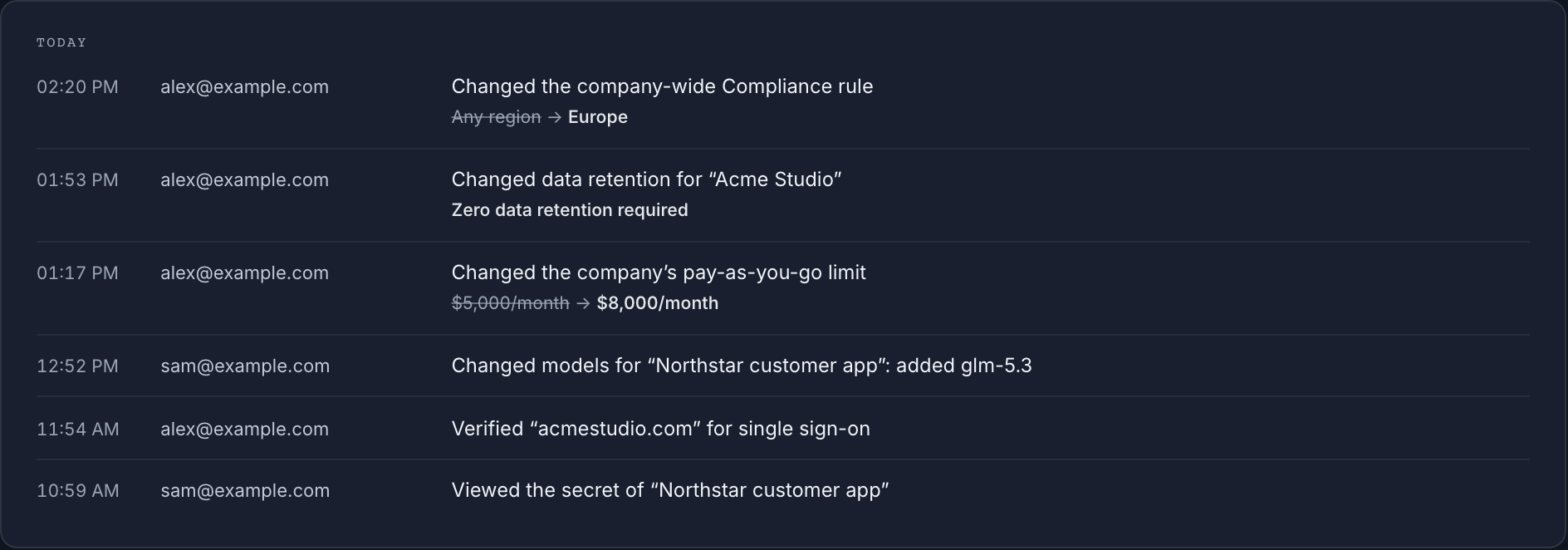
Log data, auditing and showing the AI's share. Every admin change is recorded with before and after values, and you can export a record of every request showing the model, the provider that served it and the region rule in force, kept for 12 months. Records hold metadata only, never your prompts or outputs.
Data processing agreement
Accountability. Sign our Data Processing Agreement in the dashboard in minutes. It commits us to no training on your data, no retention of your content, and breach notification within 72 hours. We publish every sub-processor with its purpose, data and location, and give you 14 days' notice before adding a new one.
Questions from IT, data protection and security
- Does the Finnish Ombudsman ban AI at work?
- No. The guidance bans no tool. It requires data protection law to be followed whenever AI processes personal data, and AI Act prohibited practices to be left out.
- Is the guidance binding?
- The obligations come from the GDPR and the AI Act, and the guidance brings their requirements together for AI systems. The office notes that it is not exhaustive and that requirements must be assessed case by case.
- Does an AI gateway make a company GDPR compliant?
- No. A gateway handles a technical part: where data is processed, retention, approved providers and models, budgets and logs. The legal basis, risk assessment and DPIA, privacy notices, the internal policy and human review remain the company's responsibility.
- Does Standard Compute keep the content of requests?
- We process your prompts in memory to serve each request and never write them to storage or logs. Request records hold metadata only: model, provider, tokens, cost and status.
Official sources
Summary based on these documents, read on 9 November 2026. It replaces neither the documents themselves nor legal advice.
- Guidelines published on ensuring data protection in the development and use of AI systems (Office of the Data Protection Ombudsman, 20 May 2025)
- Data protection in the development and use of AI systems (Office of the Data Protection Ombudsman, web guidance, published 20 May 2025)
Related
Create a company workspace, turn on the Europe rule and zero data retention, and give every app its own key and budget.