How to replace ChatGPT Enterprise with open models
Replacing a chat seat means replacing three things: the model, the chat app people type into, and the admin layer behind it (single sign-on, retention, records and spend). Open-weight models cover the first. You choose the other two, and they decide most of the effort.
This guide walks through the choices and the migration. OpenAI facts are from its own pricing and documentation pages; model licences are from each model's official card.
Short answers
- Can open models replace ChatGPT Enterprise?
- For many everyday uses, such as drafting, summarizing, coding and analysis, current open-weight models are worth testing against your seats. Test on your own tasks and keep a frontier model available for the hardest work.
- Which open models can a company use commercially?
- Check each model card. GLM 5.2 and DeepSeek V4 Pro are MIT-licensed and Qwen 3.8 27B is Apache 2.0. GLM 5.3 and Kimi K3 ship under their own licences, which you should read before deploying.
- What do you lose when you leave ChatGPT Enterprise?
- The admin layer it bundles: SAML SSO, SCIM, role-based access, domain verification, retention controls and audit logs through the Compliance API. Plan how you replace each before you migrate anyone.
Two decisions: where the model runs, and what people type into
These two choices set the cost and the work. The table pairs the hosting options with what each asks of you.
| Option | What it is | Trade-off |
|---|---|---|
| Self-host on your own GPUs | What it is: Serve open weights with a server such as vLLM, which exposes an OpenAI-compatible API | Trade-off: Full control of the data path. You pay for GPUs whether they are busy or not, and you run upgrades, scaling and on-call. |
| A hosted open-model API in Europe | What it is: A provider runs the weights and bills per token, for example Mistral AI, which hosts data in the EU by default | Trade-off: Nothing to run. Each provider has its own model list, contract and retention terms. |
| A gateway with open and frontier models | What it is: One API in front of several providers and model families | Trade-off: One contract and one admin layer. You depend on the gateway for routing and records. |
| Chat front end: Open WebUI or LibreChat | What it is: Self-hosted chat apps that connect to any OpenAI-compatible API | Trade-off: Familiar chat experience with your own SSO. You host and update the app. |
Replace ChatGPT Enterprise in eight steps
Start four months before your renewal date. ChatGPT Enterprise is billed annually, so the renewal is your deadline.
List what people use ChatGPT for
Use your workspace analytics and a short survey to group usage into five or six jobs, such as writing, summarizing documents, coding, data analysis and translation. Note which jobs use files, images or voice, because not every open model or chat app supports them.
Shortlist models and read the licences
Pick two or three candidates per job. From the model cards: GLM 5.2 and DeepSeek V4 Pro are MIT-licensed, Qwen 3.8 27B is Apache 2.0, and GLM 5.3 and Kimi K3 have their own licences. Have legal read any custom licence before you deploy it.
Test on your own tasks
Collect 30 to 50 real prompts per job with personal data removed, run them on the candidates and on your current model, and have the people who do the job rate the answers blind. Public benchmarks don't tell you how a model handles your documents.
Choose where the models run
Self-hosting fits steady, high volume and strict data-path rules. vLLM serves models through an OpenAI-compatible server, so chat apps and code that use the OpenAI SDK connect without changes (vLLM). For uneven or modest volume, per-token hosting usually costs less than idle GPUs.
Pick the chat front end and connect SSO
Open WebUI connects to an OpenAI-compatible API through
OPENAI_API_BASE_URLand supports Microsoft sign-in withMICROSOFT_CLIENT_ID,MICROSOFT_CLIENT_SECRETandMICROSOFT_CLIENT_TENANT_ID(Open WebUI SSO). LibreChat is the other common choice.OPENAI_API_BASE_URL=https://your-endpoint.example.com/v1 OPENAI_API_KEY=YOUR_KEY MICROSOFT_CLIENT_ID=... MICROSOFT_CLIENT_SECRET=... MICROSOFT_CLIENT_TENANT_ID=...Open WebUI pointed at an OpenAI-compatible endpoint Rebuild the admin layer
ChatGPT Business includes SAML SSO and MFA; Enterprise adds SCIM, role-based access control, domain verification, data residency controls, retention controls and audit logs through the Compliance API (chatgpt.com/pricing). Decide for each one what replaces it: your identity provider, the chat app's settings, your hosting provider's terms or a gateway.
Migrate in waves
Move one department at a time, starting with the job where the open model tested best. Keep a frontier model available in the same chat app for tasks the open model handles poorly, so people don't fall back to personal ChatGPT accounts.
Resize the seats at renewal
Keep ChatGPT seats only for the people whose work still needs them, or move them to Business at $20 per user a month billed annually ($25 monthly). OpenAI bills API usage separately from seats, so count any API spend in the comparison (chatgpt.com/pricing).
Where Standard Compute does these steps for you
Standard Compute is the gateway option in the table above: open and frontier models behind one OpenAI-compatible API, with the admin layer built in. Your chat front end connects with one base URL.
| Step | What Standard Compute does |
|---|---|
| Models | What Standard Compute does: Run leading open models, including GLM, DeepSeek, MiniMax and Kimi, alongside Claude, GPT and Gemini through one API. GLM, DeepSeek and MiniMax are also served by European providers for Europe-restricted workspaces. |
| Cost per task | What Standard Compute does: A single API gives you frontier and open-source models, and it routes each step to the cheapest model that can do it and the cheapest provider fast enough to serve it. |
| A frontier model when needed | What Standard Compute does: Claude, GPT and Gemini sit on the same key as the open models, so nobody needs a second account for hard tasks. |
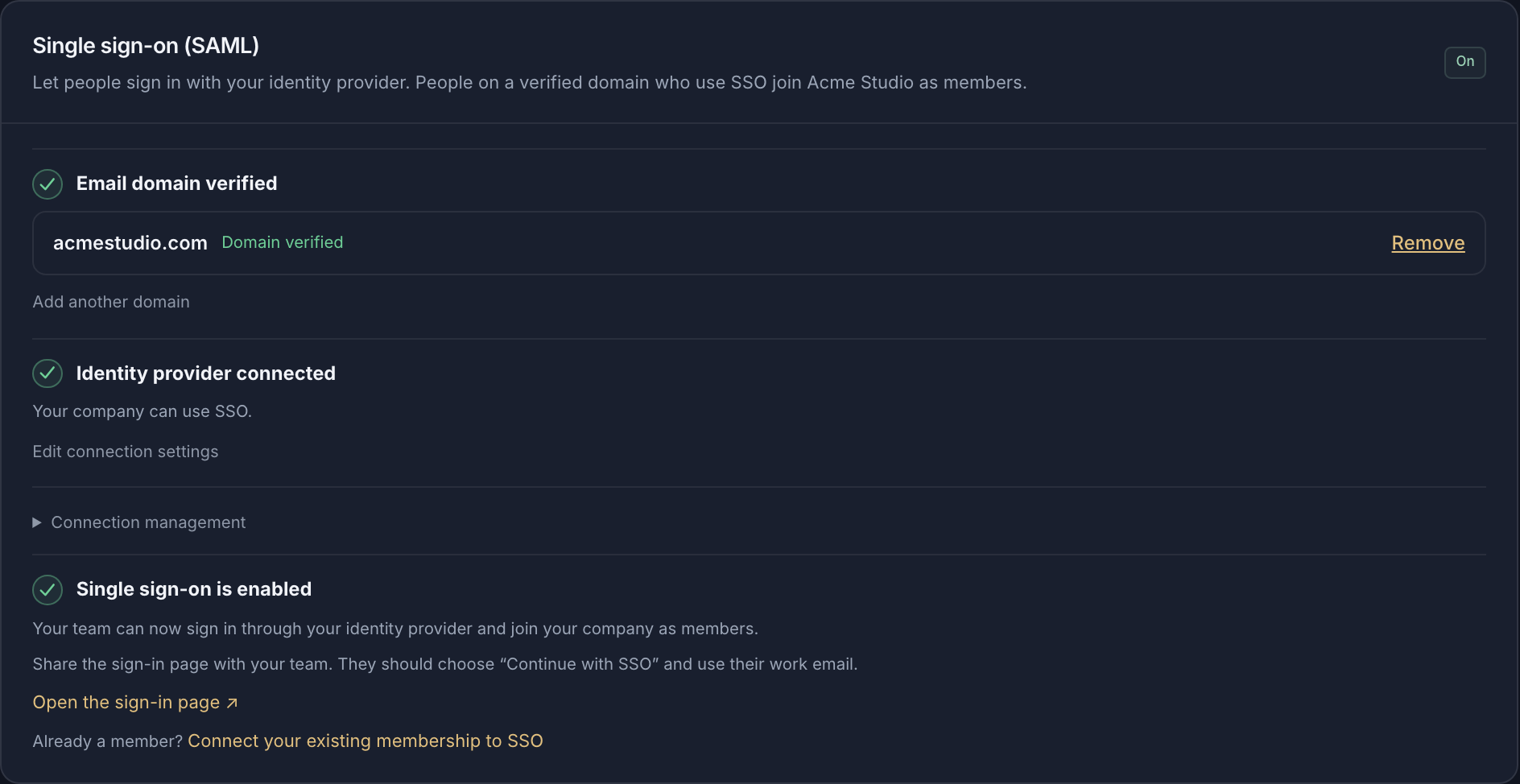
| Single sign-on | What Standard Compute does: Connect Microsoft Entra ID or any SAML identity provider so your people sign in to Standard Compute with their work accounts. Anyone on your verified domain joins your company automatically. |
| Processing in Europe | What Standard Compute does: Set a Europe rule for your company, a team or a single key, and every request, including retries and fallbacks, is served only by approved European inference endpoints. If no European endpoint can serve it, the request is refused before your prompt is sent. |
| Retention and training | What Standard Compute does: Turn on zero data retention for your company, a team or a key, and every request is routed only to inference endpoints that commit to keeping no copy of your data. Teams and keys inherit the requirement and can never switch it off underneath you. Standard Compute never trains on your prompts or outputs. With a region rule or zero retention turned on, every request goes only to providers that commit not to train on it. |
| Spend and records | What Standard Compute does: Every person and app gets a fixed monthly budget, and you can set spending caps per key and for the whole company. When a key reaches its budget it stops, unless you turn on top-off from a prepaid company balance for keys that must keep running. Every admin change is recorded with before and after values, and you can export a record of every request showing the model, the provider that served it and the region rule in force, kept for 12 months. |
OPENAI_API_BASE_URL=https://eu.stdcmpt.com/v1
OPENAI_API_KEY=YOUR_STANDARD_COMPUTE_KEYQuestions from IT, security and finance
- Is it cheaper to self-host open models than to pay for ChatGPT Enterprise?
- It depends on volume. Self-hosting is a fixed GPU cost that pays off at steady, high use; for uneven use, per-token hosting of the same models usually costs less. Compare both against your seat count at renewal.
- Can we keep some ChatGPT seats?
- Yes. Most companies keep a small number of seats for people who depend on specific ChatGPT features, and move everyone else.
- Which open models does Standard Compute serve in Europe?
- GLM, DeepSeek and MiniMax are served by European providers for Europe-restricted workspaces.
- Does Standard Compute replace the ChatGPT app?
- Standard Compute is the API and admin layer. People use a chat app such as Open WebUI or LibreChat pointed at it, or tools such as Claude Desktop, Claude Code and coding agents.
Related pages
- Open-source models for business
- Sovereign AI: self-hosting or a European gateway
- ChatGPT Enterprise alternative for API and agent access
- European AI gateway
- SSO for AI tools: Microsoft Entra ID and Claude work-account sign-in
- AI governance and spend control: budgets, allow-lists and audit
- Standard Compute for companies: the enterprise overview
Sources, checked on 7 November 2026
- ChatGPT plans and pricing
- OpenAI API: your data, retention and data residency
- GLM 5.2 model card
- GLM 5.3 model card
- DeepSeek V4 Pro model card
- Qwen 3.8 27B model card
- Kimi K3 model card
- vLLM: OpenAI-compatible server
- Open WebUI: environment variables
- Open WebUI: SSO with OAuth and OIDC
- Mistral AI: where your data is stored